Nordwest Clinic (Krankenhaus)
Qu'est-ce que la thérapie par cellules CAR-T en Allemagne ?
La thérapie par cellules CAR-T est un traitement avancé pour certains types de cancer, principalement les cancers du sang comme le lymphome et la leucémie, utilisant un récepteur antigénique chimérique. Cette thérapie utilise un récepteur antigénique chimérique pour reprogrammer les lymphocytes T du patient afin de cibler et d'attaquer spécifiquement les cellules tumorales.
Elle implique la modification des lymphocytes T (cellules immunitaires) du patient pour cibler et détruire les cellules cancéreuses. Cela améliore la capacité du corps à combattre le cancer plus efficacement.
💡 L'objectif principal de la thérapie par cellules CAR-T est d'améliorer la réponse immunitaire du corps, en particulier pour les cancers qui n'ont pas répondu aux traitements traditionnels.
❕ La thérapie par cellules CAR-T est plus efficace pour les cancers du sang agressifs, notamment lorsque la chimiothérapie ou la radiothérapie ont échoué ou en cas de récidive du cancer.

Quels sont les traitements anticancéreux disponibles ?
Les traitements anticancéreux traditionnels comme la chimiothérapie et la radiothérapie agissent en ciblant toutes les cellules à croissance rapide, provoquant souvent une immunosuppression et des effets secondaires importants.
La thérapie par cellules CAR-T est un traitement innovant qui utilise des techniques avancées pour modifier les lymphocytes T du patient afin de cibler et d'attaquer les cellules cancéreuses plus efficacement.
✅ Contrairement à la chirurgie, la thérapie par cellules CAR-T est peu invasive. Elle implique le prélèvement de lymphocytes T chez le patient, leur modification en dehors du corps, et leur réintroduction sans chirurgie.
💡Généralement utilisée pour les cancers du sang résistants à la chimiothérapie ou les cancers qui récidivent après des traitements antérieurs.
Comment la thérapie par cellules CAR-T se compare-t-elle aux autres traitements ?
La thérapie par cellules CAR-T diffère de la chimiothérapie et de la radiothérapie dans son approche. Contrairement à ces méthodes qui suppriment généralement le système immunitaire, la thérapie par cellules CAR-T le renforce pour cibler spécifiquement les cellules cancéreuses.
Qui est candidat à la thérapie par cellules CAR-T en Allemagne ?
La thérapie par cellules CAR-T est généralement recommandée pour les patients atteints de cancers du sang tels que le lymphome et la leucémie, en particulier ceux dont le cancer a récidivé ou a été résistant à la chimiothérapie. Elle est également utilisée pour traiter le cancer des ganglions lymphatiques, notamment les tumeurs agressives du système immunitaire comme les lymphomes non hodgkiniens à cellules B.
👉L'essai ZUMA-1 a démontré des résultats encourageants pour les patients atteints de lymphome diffus à grandes cellules B agressif, avec 82 % des patients montrant une réponse positive au traitement et 54 % atteignant une rémission complète. Bien que certains patients aient connu une rémission à long terme, les durées de survie ont varié.
✅Efficace pour les patients atteints de tumeurs malignes à cellules B, y compris les types agressifs de lymphome.
❗ Non recommandé pour les patients souffrant de maladies préexistantes graves comme des maladies cardiaques ou pulmonaires.
Comment la thérapie par cellules CAR-T est-elle réalisée ?

-
Préparation :
-
Des analyses de sang, de l'imagerie et parfois un cycle de chimiothérapie préparent le corps à la modification des lymphocytes T.
-
Procédure :
-
Les lymphocytes T sont prélevés chez le patient.
-
Les cellules sont modifiées en laboratoire pour améliorer leurs propriétés de lutte contre le cancer, puis réintroduites dans le corps du patient.
-
Les lymphocytes T modifiés sont ensuite réinjectés au patient.
🕒 Durée. En général, il faut compter 2 à 3 semaines entre le prélèvement des cellules et la réinjection.
Combien de temps faut-il pour récupérer ?
| 1-2 semaines | Surveillance à l'hôpital pour détecter des effets secondaires comme le syndrome de libération de cytokines ou une infection. |
| Semaines 3-4 | Bien qu'une légère fatigue puisse persister, retour aux activités normales. |
| 1-6 mois | La récupération complète peut prendre des mois, avec des rendez-vous de suivi réguliers et des restrictions sur les activités intenses. |
Quels sont les risques et complications ?
La thérapie par cellules CAR-T est généralement sûre pour la plupart des patients. Cependant, comme tout traitement impliquant la modification des cellules du système immunitaire, elle comporte certains risques.
💡 Effets secondaires courants : fièvre, fatigue et tension artérielle basse.
❗ Complications rares : problèmes neurologiques et syndrome de libération de cytokines (surréaction du système immunitaire).
✅ Choisissez des centres de traitement accrédités et expérimentés avec Bookimed pour réduire les risques et garantir les meilleurs soins.
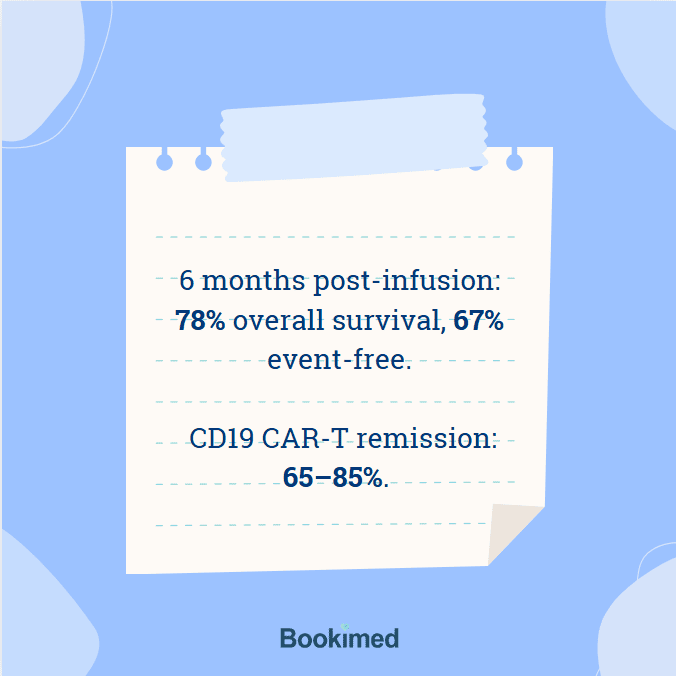
👉Une étude a révélé que 78 % des patients étaient en vie six mois après la perfusion, et 67 % n'avaient aucun événement majeur lié à la maladie. Pour les thérapies CAR ciblant CD19, les taux de rémission variaient entre 65 % et 85 %, la survie à long terme dépendant du type de traitement — la thérapie, par exemple, a montré un taux de survie global de 55 % à 5 ans.
Résultats : quand s'attendre à un effet ?
Des résultats visibles peuvent être observés dans les 1 à 2 mois suivant la thérapie par cellules CAR-T.
💡 La rémission complète peut prendre plus de temps, et certains patients peuvent nécessiter un deuxième cycle de traitement pour obtenir les résultats souhaités.
L'efficacité de la thérapie peut durer de quelques mois à plusieurs années, bien que certains patients puissent subir une récidive.
Pourquoi choisir la thérapie par cellules CAR-T en Allemagne ?
L'Allemagne est une destination de premier plan pour la thérapie par cellules CAR-T, offrant des soins médicaux de pointe et des prix compétitifs. L'Allemagne devient l'un des principaux pays pour le tourisme médical. Le secteur devrait passer de 7,2 milliards de dollars en 2025 à 17,3 milliards de dollars d'ici 2035.
-
Économies de coûts. La thérapie par cellules CAR-T en Allemagne peut permettre d'économiser jusqu'à 40 % par rapport aux traitements aux États-Unis et au Royaume-Uni.
-
Établissements accrédités. De nombreuses cliniques allemandes sont accréditées par des organismes internationaux comme la JCI, garantissant des normes de classe mondiale.
-
Technologie avancée. Les hôpitaux allemands utilisent des technologies d'édition génétique de pointe comme CRISPR pour améliorer la thérapie par cellules CAR-T.
-
Spécialistes expérimentés. Les médecins en Allemagne ont une formation approfondie et sont membres d'organisations telles que la DGHO et l'ESMO.
-
Accessibilité pratique. L'Allemagne est facilement accessible, avec des vols directs depuis les États-Unis prenant 8 à 10 heures et seulement 1 à 2 heures depuis le Royaume-Uni.
Trouvez des avis authentiques de patients sur leurs expériences de traitement.
Que dois-je savoir avant de voyager en Allemagne ?
- Exigences en matière de visa. La plupart des patients internationaux peuvent entrer en Allemagne pour une durée allant jusqu'à 90 jours sans visa.
- Les patients séjournent généralement 2 à 3 semaines pour le traitement, avec des visites de suivi si nécessaire.
💳 Les cliniques acceptent généralement les cartes de crédit ; vérifiez auprès de votre clinique les politiques de paiement spécifiques.
Combien coûte la thérapie par cellules CAR-T en Allemagne ?

Le coût de la thérapie par cellules CAR-T en Allemagne varie de 330 000 $ à 440 000 $, ce qui est nettement inférieur aux États-Unis, où les coûts peuvent dépasser 475 000 $.
💡 Le coût peut varier en fonction de la complexité du cas et de l'emplacement de la clinique.
✅Le prix comprend généralement la thérapie, le séjour à l'hôpital et certains soins de suivi. Les frais supplémentaires peuvent inclure le voyage, l'hébergement et des tests supplémentaires.
Qu'est-ce qui est inclus dans les forfaits de thérapie par cellules CAR-T en Allemagne ?
💚 Offres de forfaits : Les forfaits tout compris de thérapie par cellules CAR-T en Allemagne offrent un plan de traitement complet, souvent à une meilleure valeur que la réservation de chaque service séparément.
Ces forfaits comprennent généralement :
-
Consultations pré-traitement et tests diagnostiques.
-
Prélèvement, modification et réinjection des cellules.
-
Hébergement et transferts entre la clinique, l'hôpital et l'hôtel.
-
Suivi post-traitement jusqu'à 2 semaines.
-
Soins de suivi et assistance à distance.
💚Pour des informations détaillées, Bookimed assure une tarification transparente et peut vous assister tout au long du processus de traitement, de la consultation aux soins post-traitement.
Références
-
Cappell K. M., Kochenderfer J. N. Long-term outcomes following CAR T cell therapy: what we know so far. Nature Reviews Clinical Oncology. 2023. URL: https://doi.org/10.1038/s41571-023-00754-1 (date d'accès : 04.04.2025).
-
De Marco R. C., Monzo H. J., Ojala P. M. CAR T Cell Therapy: A Versatile Living Drug. International Journal of Molecular Sciences. 2023. Vol. 24, no. 7. P. 6300. URL: https://doi.org/10.3390/ijms24076300 (date d'accès : 04.04.2025).
-
Germany Medical Tourism Market Size & Trends 2025-2035. Market Research and Consulting | Future Market Insights, Inc. URL: https://www.futuremarketinsights.com/reports/germany-medical-tourism-market (date d'accès : 04.04.2025).